
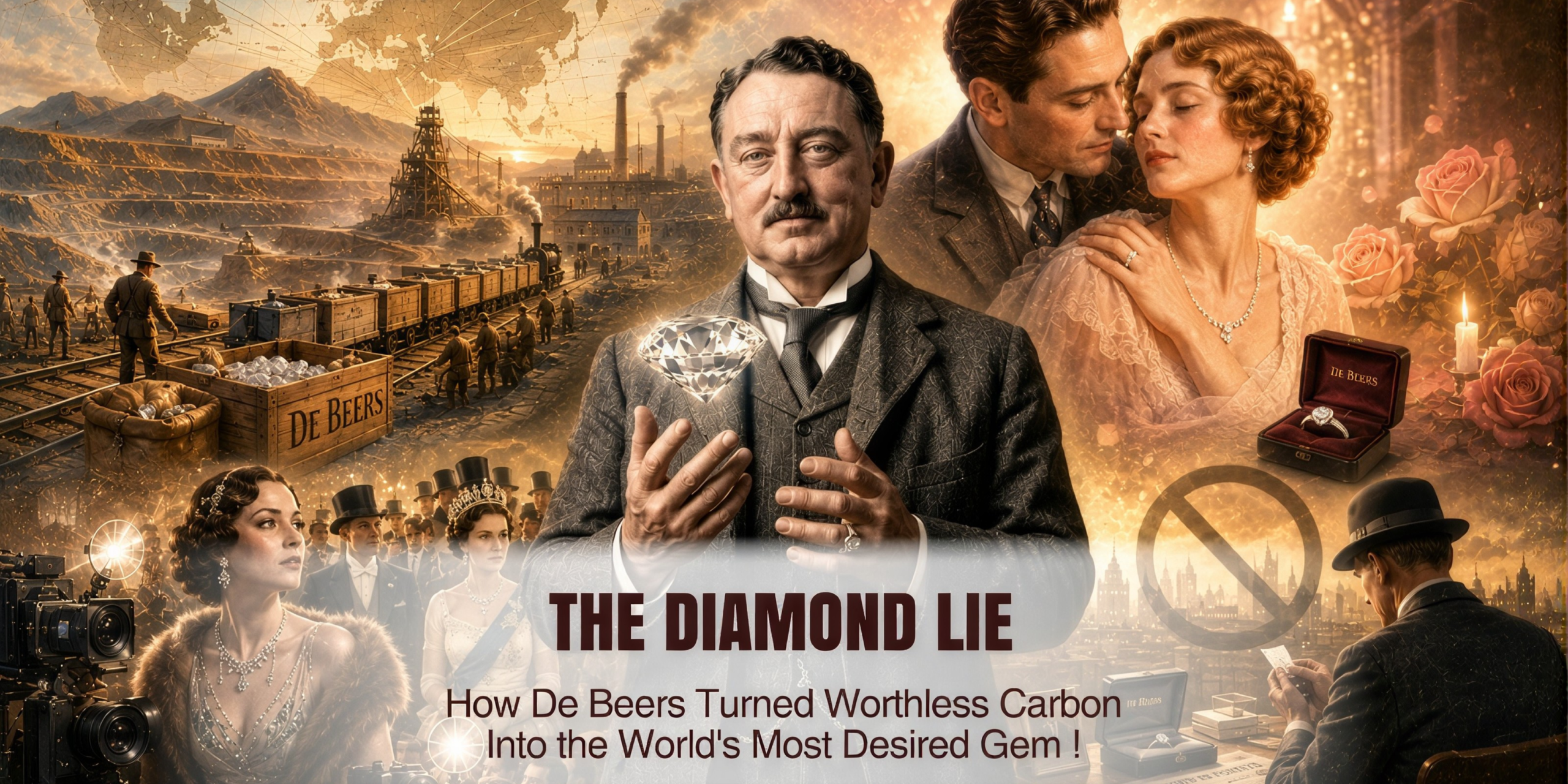
How De Beers Turned Worthless Carbon Into the World’s Most Desired Gem
Marketing Strategy · Brand Psychology · Monopoly Economics
PART I — THE TRUTH NOBODY TOLD YOU
Here is something the diamond industry has spent over a century making sure you never find out: diamonds are not rare. They are not precious by nature. They are not a symbol of love that humanity arrived at organically. They are compressed carbon — one of the most common elements on earth — and almost everything you believe about them was carefully, deliberately, and brilliantly manufactured by one company.
That company is De Beers. And what they pulled off is arguably the greatest marketing con in the history of modern commerce.
“A diamond loses up to 50% of its value the moment you walk out of the jewellery store. Over 110 million carats are mined every year. They were never rare. You were just told a story.”
This is not a conspiracy theory. It is documented history — backed by legal proceedings, declassified advertising briefs, and De Beers’ own records. In 2004, De Beers pleaded guilty to criminal price fixing in a U.S. federal court. In 2012, the U.S. Supreme Court refused to hear their appeal against a class action settlement for unfair business practices. The story of diamonds is the story of how a product with almost no intrinsic value was turned into a cultural necessity — and how an entire civilisation was made to feel guilty for not buying one.
110M+
Carats mined every year 50%
Value lost on purchase $5.2B
De Beers’ London stockpile (1999)
PART II — THE VILLAIN: CECIL RHODES & THE BIRTH OF DE BEERS
The story begins in 1870 in the dusty plains of South Africa. Massive diamond deposits were discovered near the Orange River, setting off the first great diamond rush. For a brief moment, it looked like diamonds might become affordable to everyone — a semi-precious stone, nothing more.
That terrified the investors. When supply goes up, prices come down. Basic economics. So a young, ruthless British entrepreneur named Cecil Rhodes did something audacious: he bought every mine he could find.
One farm where diamonds were first found was owned by two brothers named De Beer. Rhodes purchased it — forcefully — and used it as the foundation for what would become De Beers Consolidated Mines in 1888. By 1902, De Beers controlled 90% of the world’s rough diamond production and distribution. It was the most successful cartel arrangement in the history of modern commerce.
But owning the mines was only half the battle. The real genius was what they did next.
KEY TIMELINE
1870 The Diamond Rush
Massive deposits discovered in South Africa. Prices threatened to collapse.
1888 De Beers is Born
Cecil Rhodes consolidates all mines into one cartel. 90% of global supply controlled.
1938 The Brief
De Beers hires N.W. Ayer ad agency during the Great Depression. Mission: manufacture need.
1947 “A Diamond is Forever”
Frances Gerety writes the most successful advertising slogan of the 20th century.
1960s Japan Expansion
Zero diamond tradition. De Beers creates one. Japan becomes a top diamond market.
1980s Two Months Salary
De Beers tells men what love costs. Anchoring psychology at industrial scale.
2004 Federal Guilty Plea
De Beers pleads guilty to criminal price fixing in U.S. federal court.
PART III — THE TRICK: MANUFACTURING SCARCITY
The first pillar of the De Beers strategy was supply control — and it was executed with surgical precision. Rather than letting the market determine prices, De Beers stockpiled billions of dollars worth of diamonds in a London warehouse and released only a controlled trickle each year. By 1999, that stockpile was valued at $5.2 billion.
Access to rough diamonds was granted only to a hand-selected group of buyers called ‘sightholders’ — and only at prices set by De Beers. There was no negotiation. You either bought at their price or you didn’t buy at all. This wasn’t a market. It was a monarchy.
The result: unlike gold, silver, or virtually every other commodity, diamond prices never crashed. They crept steadily upward year after year — not because of genuine demand, but because De Beers simply would not allow them to fall. They manufactured scarcity out of abundance. They made you believe you were holding something rare when the earth produces millions of carats of it every single year.
“Diamonds aren’t rare. But De Beers made them feel rare. And when you control perception, you control price.”
The second pillar was psychological — and far more sophisticated. Controlling supply was the economic lever. But desire? Desire had to be built from scratch.
PART IV — THE PSYCHOLOGY: ENGINEERING DESIRE
In 1938, with diamond sales stalling during the Great Depression, De Beers approached the New York advertising agency N.W. Ayer with an extraordinary brief: convince an entire nation that diamonds were not a luxury — they were a necessity. A requirement of love itself.
The agency’s strategy was multi-layered. They placed diamonds on the fingers of Hollywood actresses. They seeded editorial content in fashion magazines. They arranged for celebrities to wear diamonds at high-profile events — not as paid advertising, but as organic cultural endorsement. They understood something fundamental before the rest of the world had a word for it: the most powerful marketing never looks like marketing.
Then in 1947, a tired copywriter named Frances Gerety scribbled four words at the end of a late-night work session before going to sleep: A Diamond is Forever. She almost didn’t submit it. It went on to be voted the greatest advertising slogan of the 20th century by Advertising Age.
The genius of the line was layered. On the surface, it spoke of eternal love. Underneath, it contained a message that was economically devastating for any thought of resale: if a diamond is forever, you don’t sell it. You don’t hand it down as cash value. You keep it. This single sentence effectively destroyed the secondary diamond market — ensuring that millions of diamonds held by consumers never re-entered circulation and undermined De Beers’ manufactured scarcity.
$23M
De Beers sales in 1939 $2.1B
De Beers sales by 1979 80%
Engagement rings with diamonds by 1990
But De Beers did not stop at making diamonds desirable. They made not buying one a social failure.
The campaign rolled out in phases. First, they established that a diamond engagement ring was the only acceptable proposal. Then they told men precisely how much love was supposed to cost. The original suggestion — one month’s salary — quietly doubled to two months by the 1980s with the line: ‘How can two months’ salary last forever?’ The implication was clear: spending less meant loving less.
When De Beers entered Japan in the 1960s — a country with zero tradition of diamond engagement rings — they did not adapt to the culture. They replaced it. Within a generation, Japan had one of the highest rates of diamond engagement ring purchases per capita in the world. De Beers told them to spend three months’ salary. And they did.
PART V — THE GUT PUNCH: WHAT YOU ACTUALLY BOUGHT
Here is what no jeweller will tell you when you hand over your life savings across a glass counter: the moment you walk out of the store, your diamond has already lost up to 50% of its value. Not because it degraded. Not because it cracked. Because the spread between wholesale and retail in the diamond industry is enormous — and a jeweller will only buy back at wholesale.
Unlike gold, which tracks commodity markets and can be melted and revalued, a diamond’s price is based almost entirely on a manufactured perception of rarity and emotional significance. Strip away the marketing and you are holding a piece of compressed carbon that the earth produces by the hundreds of millions of carats every single year.
De Beers was so aware of this that they deliberately suppressed the idea of diamond investment. They did not want you thinking of your ring as an asset — because assets get liquidated, sold, and recycled back into the market. A diamond ‘investment’ that you never sell is not an investment at all. It is a one-way purchase that permanently removes a stone from circulation and permanently protects De Beers’ manufactured scarcity.
“De Beers didn’t sell diamonds. They sold a feeling — guilt dressed up as romance, status dressed up as love. And the world paid billions for it.”
PART VI — WHY IT WORKED: THE STRATEGIC MASTERCLASS
The De Beers story is not just a cautionary tale about manipulation. It is a masterclass in how markets, psychology, and culture intersect. Four specific mechanisms made it work at a civilisational scale.
1st: they controlled the supply chain entirely. When you own the source, the processing, and the distribution, you own the price. De Beers’ ‘sightholder’ system meant no competitor could undercut them — you played by their rules or you didn’t play.
2nd: they attached the product to an emotion that has no ceiling. Love is not a rational purchase. When De Beers linked diamonds to love, commitment, and marriage, they moved the purchase outside the domain of economic logic. You do not comparison-shop for love. You do not ask if love is worth it. And so you do not ask if the diamond is worth it either.
3rd: they engineered social proof at scale. By placing diamonds on movie stars, in editorial spreads, and on the hands of royalty, they made diamonds the visible currency of status and devotion. Not buying one stopped being a personal preference. It became a social statement — and not a flattering one.
4th: they built in a resale blocker. ‘A Diamond is Forever’ was not just romantic poetry. It was an economic instruction. It told consumers that resale was culturally inappropriate — that selling a diamond engagement ring was tantamount to selling the love it represented. This single psychological barrier protected their entire supply control strategy from being undermined by a secondary market.
90%
Global supply controlled at peak 75+
Years ‘A Diamond is Forever’ ran uninterrupted 3 months
Salary De Beers told Japan to spend
CLOSING — THE LESSON
The diamond industry today is fracturing. Lab-grown diamonds — chemically identical to mined ones — cost 80–90% less and are increasingly popular with younger buyers who have done the research. Millennials and Gen Z are choosing alternative stones, heirloom rings, and in some cases, no ring at all. De Beers itself entered the lab-grown market before shutting down that venture in 2025 — a sign that even they could not contain the information age.
But here is the most important takeaway: the De Beers story did not work because people were stupid. It worked because the strategy was genuinely brilliant. It identified a universal human desire — to prove love, to signal status, to belong — and attached a product to it with such cultural precision that questioning the product felt like questioning the value.
Value is not inherent. Value is a story. De Beers just wrote it better, earlier, and more completely than anyone before or since. Understanding that story does not diminish love. It reveals something far more powerful: that perception, when engineered with enough skill, becomes reality.
“They didn’t sell diamonds. They sold the idea that not having one meant you loved less. That’s not marketing. That’s architecture of the mind.”