
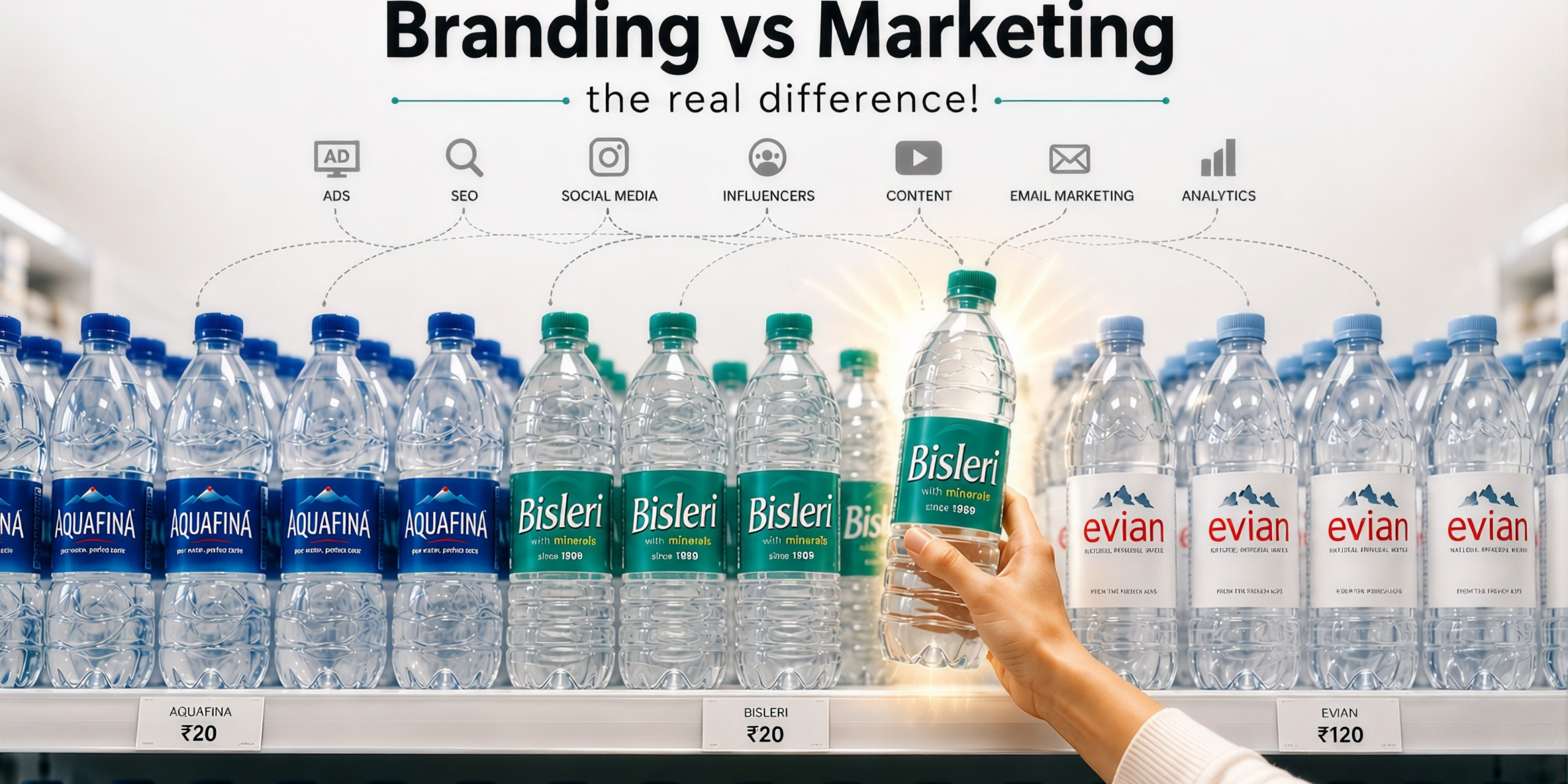
Take three bottles of water, without labels. What are they to you? Chances are that they are just three bottles of water. They could be the same brand, no one would know. Now put the labels of Bisleri, Aquafina, and Evian. Suddenly, each bottle has its own personality. Each bottle has its own value and message – this is branding.
On the other hand, marketing is when we use tactics to drive awareness, engagement, leads, and sales. It is to generate demand and encourage action.
Every business we talk to in 2026 is spending more on marketing than they were two years ago. Google Ads, Instagram reels, SEO, influencer tie-ups, AI-generated content at a pace nobody could manage manually. And yet – ask most founders if their customers actually remember them, and the answer gets quiet fast.
That’s not a marketing problem. That’s a branding problem wearing a marketing costume.
Marketing gets you found. Branding gets you remembered.
That’s the main branding vs marketing difference. As a branding and marketing agency in India, we’ve watched this play out the same way across nearly every client at White Warbler, regardless of category – healthcare, education, D2C food, SMEs. Marketing is the megaphone. It’s SEO, performance ads, email, influencer content – anything designed to put your name in front of someone today. Branding is the reason they care once they hear it. It’s the positioning, the tone, the visual identity, the experience – everything that decides whether your name sticks or slides right off them.
Skip branding and your marketing still “works” – clicks happen, traffic shows up – but every single customer has to be convinced from zero, every single time. That’s expensive. It’s also exhausting, and it’s why so many brands feel like they’re running faster every quarter just to stay still.
Case Study – Makhanawala’s
Makhana brands are having a moment. Walk through any modern grocery aisle and you’ll see five, six, seven brands all making roughly the same claim: protein-rich, guilt-free, ancient Indian superfood. Most of them are selling a good product through a generic story – and most of them are interchangeable the second a competitor undercuts them on price.
One brand we’ve worked with – Makhanawala’s – took a different route. Instead of leading with “healthy snack,” they led with where it actually comes from: ponds in Bihar’s Mithila region, a family that’s been at this since 1941, a story specific enough that no competitor with a bigger ad budget can simply copy it. You can outspend someone on Meta Ads. You can’t outspend them on eighty-five years of provenance you don’t have.
That’s the whole difference in one comparison. The generic brand’s marketing works exactly as hard as its budget allows. The specific brand’s marketing works harder than its budget, because the story is doing labor the ad spend isn’t paying for.
Why this gap is widening, not closing, in 2026
AI didn’t just make marketing content faster to produce – it made it cheaper to copy. Any competitor can now generate a blog, a caption set, a video script in the time it used to take to brief a writer. Which means the content itself stopped being the differentiator somewhere around 2024. What’s left to differentiate you is the thing AI can’t generate for you off a prompt: an actual point of view, built over time, that customers recognise as yours.
That’s branding. And it’s now doing more competitive work than it has in a decade.
The tell that your branding is the weak link
You probably don’t need a brand audit to know if this is you. A few honest questions usually do it:
- Do customers mostly talk to you about price?
- Could someone swap your logo for a competitor’s and not notice for a week?
- Has your messaging changed three times this year because nothing felt “right”?
- Do your own employees struggle to explain, in one sentence, what makes you different?
- Are your campaigns getting clicks but not repeat customers?
If two or more of those land, the issue isn’t your media spend. It’s that there’s no foundation underneath it for the spend to build on. That’s why branding matters in 2026.
Branding and marketing aren’t rivals – they work together
Think of marketing as your revenue this quarter, and branding as your valuation three years from now. One pays the bills today. The other is the reason your customer acquisition cost doesn’t keep climbing every year while your competitors’ does.
A trustworthy brand makes its Google Ads convert better, because the click already arrives half-convinced. A clearly positioned institution sees stronger enquiry-to-admission rates, because prospective students aren’t starting the decision from scratch. A D2C brand with packaging and a story people actually retell gets repeat purchases out of the same media budget a weaker brand would burn through for a single sale.
What an integrated agency actually does differently
Most agencies sell you a channel – SEO, paid social, performance ads – and let you assemble the brand yourself, if at all. At White Warbler, we start with questions most marketing briefs skip entirely: who is this actually for, what makes you genuinely different from the three competitors who look just like you, and what’s the one thing you want a customer to feel that no ad alone can manufacture.
Only after that do we build the campaigns. Not because branding is more important than marketing – it isn’t, they’re not in competition – but because a campaign without a brand underneath it is just spending money to feel busy.
So – should you fix your brand first, or your marketing?
The right question is: which one is currently undermining the other? For most businesses we meet, it’s the brand side that’s thin, and the marketing budget is quietly compensating for it – at a markup, every single month.
Fix that, and the marketing you’re already paying for starts working harder without you spending another rupee on it. At WWC, we look after both. Connect with us and let us build your brand and increase your marketing efforts manifold to create the best possible outcomes today.